
Odds of Having Twins Calculator
Estimate your educational chance of having twins based on age, family history, body details, and conception method.
V1.0Why this result?
Quick Tips
If you came here to get a straight number, this page does that. It also tells you what that number means, and what it does not mean.
You don’t usually Google twin odds when you feel “casual.” You search it when something in your life makes the idea feel possible. A family story. A fertility plan. A late period. A weird gut feeling. Then you want a straight answer that sounds real.
A calculator can help, but only if you read it the right way. The number is not a promise. It is a statistical estimate based on patterns seen in large groups of people. Two people can enter the same details and still get different outcomes. Ultrasound confirms twins. Everything else stays in the “estimate” lane.
Quick guide: enter your age range, height, and weight first. Pick your region and ancestry baseline. Add pregnancy history and fertility method if they apply. Use the checkboxes only for real risk factors. Press calculate, then read “Why this result?” before you focus on the percent.
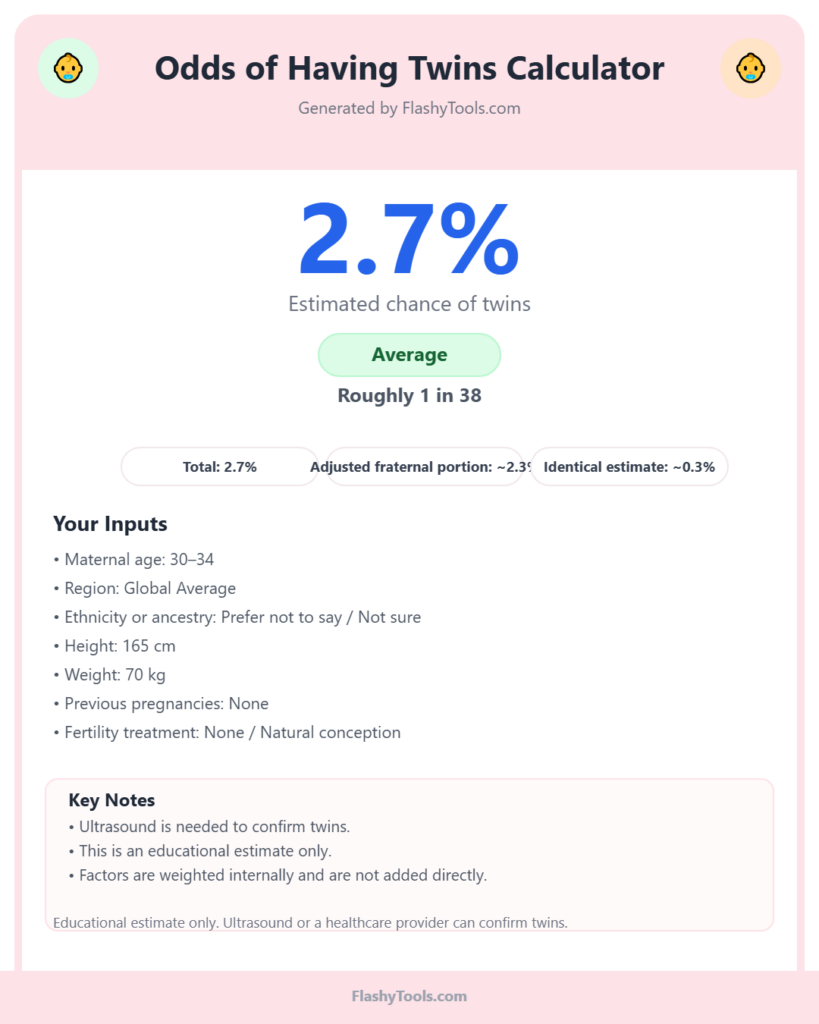
Region Baseline: Global Average
Ethnicity or Ancestry: Prefer not to say / Not sure
Height: 165 cm
Weight: 70 kg
Previous Pregnancies: None
Fertility Treatment: None / Natural conception
Fraternal vs identical: the big difference
Twins sound like one simple idea. Real life splits it into two very different paths. This is the main reason people feel a calculator “acts weird.” Fraternal twins start with two eggs in the same cycle. Two eggs can release, then both can fertilize. This part changes more from person to person. Age range matters. Maternal family history can matter. Fertility treatment can also push the odds up.
Identical twins start with one embryo. That embryo splits into two. This estimate stays steadier. Family history and daily habits do not move it as much as fraternal factors do. Your result can show a bigger fraternal portion when several risk factors stack up. The identical estimate often stays close to the same small range.
Natural twins don’t come from one magic switch
People love one clear reason. Real life does not work that way. Natural twin odds usually come from a small baseline, then a few factors nudge it up or down. Age matters, especially after 30 and after 35. The body can release more than one egg in a cycle more often as age rises, then patterns can shift again later. That’s why searches like “chances of having twins after 30” and “chances of having twins after 35” stay popular year after year.
Family history also matters, but not all family history matters the same way. Maternal-side history tends to connect more directly to fraternal twins because it relates to ovulation tendency. That’s also why people search “odds of having twins again” after a twin pregnancy. It can be higher than baseline, but it still is not guaranteed. Body size can play a role, but it often stays in the “small adjustment” category. It rarely beats fertility treatment, strong family history, or age range.
Twin odds by age: after 30 vs after 35
Most users don’t want a lecture. They want a reality check.
They are asking things like:
- I’m 31. Is it more likely now?
- I’m 36. Did my chances jump?
- I’m 40+. Does it drop again?
A calm way to frame it on your tool page is to keep the age ranges simple and avoid big claims. Under 25 often sits lower than baseline. Late 20s often looks closer to baseline. Early 30s often trends slightly higher. Mid-to-late 30s often sits higher again. After 40 is not a clean straight line for everyone, and fertility support becomes a bigger driver than “age alone.” Avoid phrases like “peak twin rate.” People read that as certainty. It also invites arguments you don’t need on a tool page.
Ovulation-based odds should sound simple
When people type “odds of having twins calculator based on ovulation,” they usually mean one of three things. They used ovulation medication such as clomiphene or letrozole. They used IUI with stimulation. Or they believe they have strong ovulation signs and wonder if that alone raises odds. Ovulation-stimulating medicine can increase the chance that more than one egg releases in the same cycle. That can push fraternal twin odds up. The size of the effect depends on the dose, monitoring, and how the body responds. A calculator can only estimate direction and rough range.
If your tool includes fertility options, show those options clearly in the breakdown. Users expect them to be the biggest driver when selected. When the breakdown feels vague, trust drops fast.
IVF and double embryo transfer should pop in the results
People use the breakdown to check one thing: “Did the tool notice the big factor?” IVF can be that big factor, so the result must show it clearly.
Two embryo transfer often raises twin odds more than most other choices. Users expect a clear jump when they select it. If the number barely moves, they will think the tool is wrong.
Two-embryo transfer often creates the biggest jump in this tool, so the breakdown highlights it clearly.
Single embryo transfer can lower twin odds, but it does not remove them. An embryo can still split, so identical twins can still happen.
Clinics follow different transfer rules. Age and medical history matter too and that is why the tool should stay careful with the wording. It should give an estimate, not a promise.
Week-by-week: what you can trust
People search week by week twin odds when they feel nervous. They want calm, not math.
A calculator can’t tell you a new twin probability each week that means something medical. Twin odds do not rise like a progress bar. The real change happens in what doctors can see and confirm. Early scans can miss a second sac. A later scan can show twins more clearly. Symptoms can feel strong, but they do not prove twins. Ultrasound confirms twins. Use “week by week” as timing guidance only. It can help you understand when confirmation becomes more reliable. It should not act like a weekly prediction tool.
Chinese twin predictor: keep it polite, keep it honest
People share the Chinese twin predictor because it feels fun and simple. Many treat it like a tradition, not science. It often shows up in family chats and social posts, so it’s normal to feel curious about it. A tool page does not need to mock it. A tool page also should not treat it as medical proof. A calm, respectful note works better than a long debate.
People use it as a cultural tradition and it does not diagnose pregnancy. It does not confirm twins, It also can’t replace an ultrasound or advice from a healthcare provider. This calculator uses measurable factors such as age range, family history, and fertility method. Even then, it still gives an estimate, not a promise. Ultrasound remains the clear way to confirm twins.
If you already had twins, your next odds can change, but nothing is “locked in”
A past twin pregnancy can change what the tool shows next time. Many people miss this point. They assume twins will happen again, or they assume it can’t happen again. Both ideas can mislead you. Fraternal twins can repeat more often than people expect. Two eggs can release in one cycle again, especially if your body tends to do that. A prior fraternal twin pregnancy can hint at that pattern. Your estimate may rise for that reason.
Identical twins work differently. One embryo splits. That event does not follow the same family pattern as fraternal twins. Your next identical odds usually stay close to the normal range. Fertility history also matters. A natural cycle and a stimulated cycle do not behave the same way. If you used treatment before, the tool should reflect that when you select it.
A simple line that helps most readers: a previous fraternal twin pregnancy can raise the estimate more than a previous identical twin pregnancy.
Body type and twins: what people mean, and what the tool should say
People ask about body type because they want a clear reason. Most mean height, weight, or build. Some research links body size to fraternal twins in certain groups. The effect is usually small. Age, maternal family history, and fertility treatment tend to matter more. Your tool should treat body profile as a mild adjustment. It should not act like body type decides twins. That keeps the result realistic and helps users trust what they see.
How to increase chances of twins naturally? Keep it safe and realistic
People ask this because they want control. They want a simple trick. Real life does not work like that. You can’t safely “aim” for twins at home. Twins happen when biology lines up in a certain way. Some factors sit outside your control. You can support fertility health, but that is different from trying to cause twins. Basic health habits may help your body function well. They do not guarantee a twin pregnancy.
Fertility treatment can raise twin odds more than most natural factors. Doctors watch those cycles closely because multiple pregnancies can carry higher risks. That is why the tool should treat treatment options as a major driver.
If you want safe, practical steps, keep them general:
- Track your cycle so you know your timing.
- Talk to a clinician if you suspect PCOS, thyroid issues, or ovulation problems.
- Ask a doctor before you take any ovulation drug or supplement.
- Focus on overall health, not a “twins goal.”
Avoid “do X to get twins” promises. They create false hope and can push people toward unsafe choices.
If medication is part of your plan, a simple schedule helps. Try our Medicine 3 Times a Day Calculator to space doses evenly.
Faith questions come up often, so answer them with respect
Some people ask, “What does God say about twins?” Twins can feel special and emotional. Many families see them as a blessing.
Different faith traditions share stories that include twins. People also interpret those stories in different ways. This page does not need a debate. A simple, respectful point helps most readers. Faith can give comfort. Medical confirmation still comes from ultrasound and healthcare care. Both can exist in the same space.
Country searches: NHS, UK, Australia, India
People search country versions because they want trust. They want to know the tool fits their situation. Your calculator can stay global and still be clear. It uses broad population baselines plus your inputs. It does not act like one country has one “official” twin number. Healthcare systems such as the NHS do not give one universal twin odds figure for every person. Regional twin rates can differ. Personal factors can differ even more.
If you use fertility treatment, local clinic rules matter a lot. Your provider can explain what applies to your case. Use this tool as an estimate, then use medical care to confirm results and plan next steps.
One paragraph that builds trust fast
Adjusted fraternal is one part of the total. It is not a separate total. This calculator does not “predict” twins. It estimates odds based on patterns seen in large groups of pregnancies. The tool starts with a baseline rate, then adjusts the fraternal portion using your age range, family history, pregnancy history, body profile, and fertility method. Identical twin odds stay more stable and do not swing the same way. The tool weights factors internally, so it does not add them like simple math. This short explanation stops most “your math is wrong” complaints because it tells people what the number really is.
Common confusion that makes people leave
A higher total does not mean twins will happen. A low result does not mean twins can’t happen. IVF options can change odds more than most natural factors. Symptoms can feel strong, but they don’t confirm twins and Only an ultrasound can confirm twins.
Twins Odds FAQs
Tap a question to show the answer.
More health tools are available in our Health & Wellness Calculators hub.