
Half Birthday Calculator
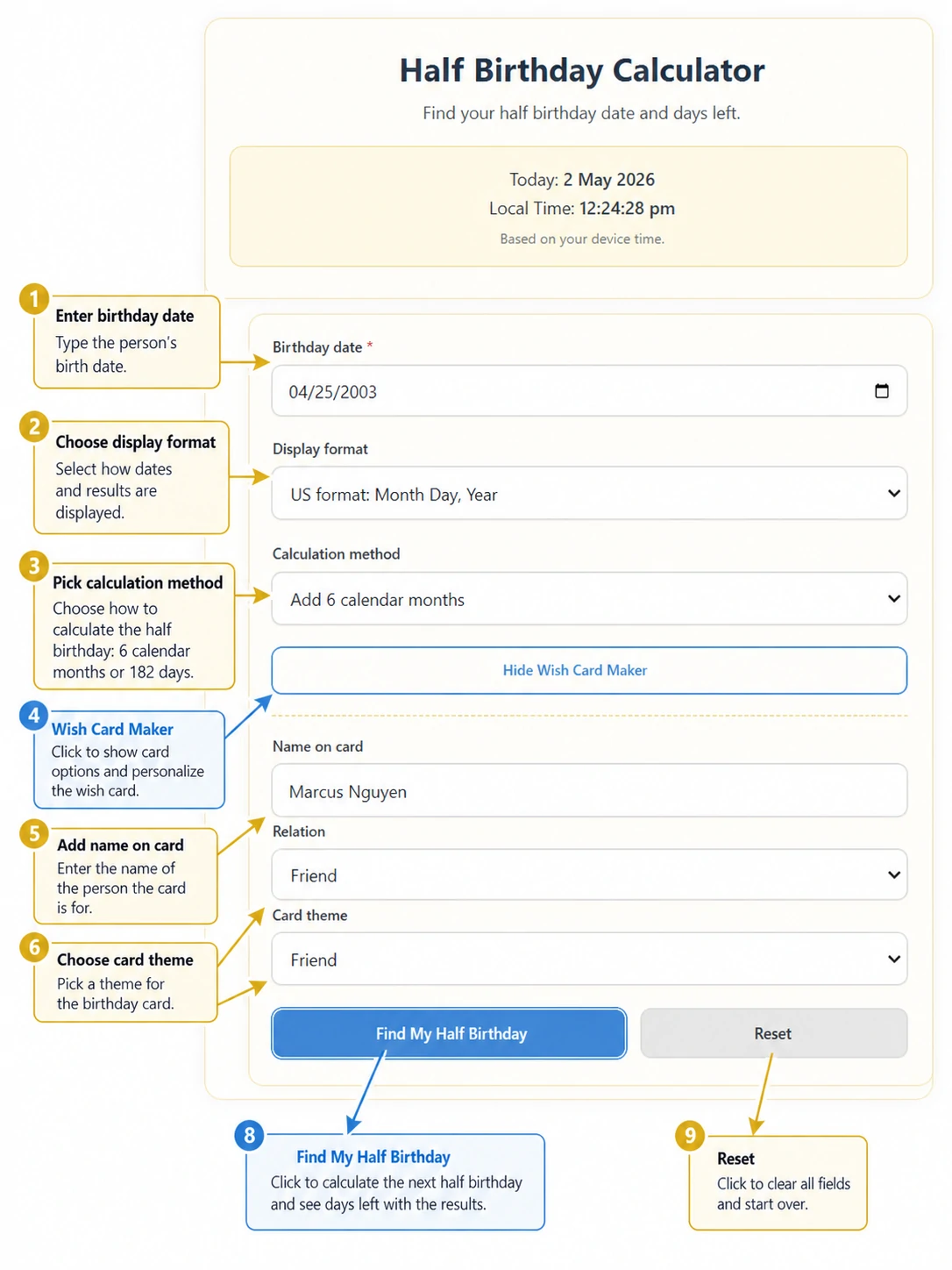
Find your half birthday date and days left.
This calculator shows your next upcoming half birthday from today. It also adjusts month-end and leap-year dates.
Two calculation options you can choose
| Option | What it does | Best use | Example |
|---|---|---|---|
| Add 6 calendar months | Moves the month ahead by 6 | Normal calendar results | Apr 10 → Oct 10 |
| Add 182 days | Uses a fixed day gap | Strict spacing | Jun 1 → Nov 30 or Dec 1 |
Your calendar will humble you
Ask someone their half birthday and watch what happens. They do not answer fast. They squint a little, then start doing quiet math. Some people grab their phone. Others throw out a guess and move on. The idea sounds clean. A birthday lands once a year, so the halfway point should land six months later. Plenty of dates behave exactly like that. April flips to October. January flips to July. You get a neat match and it feels solved.
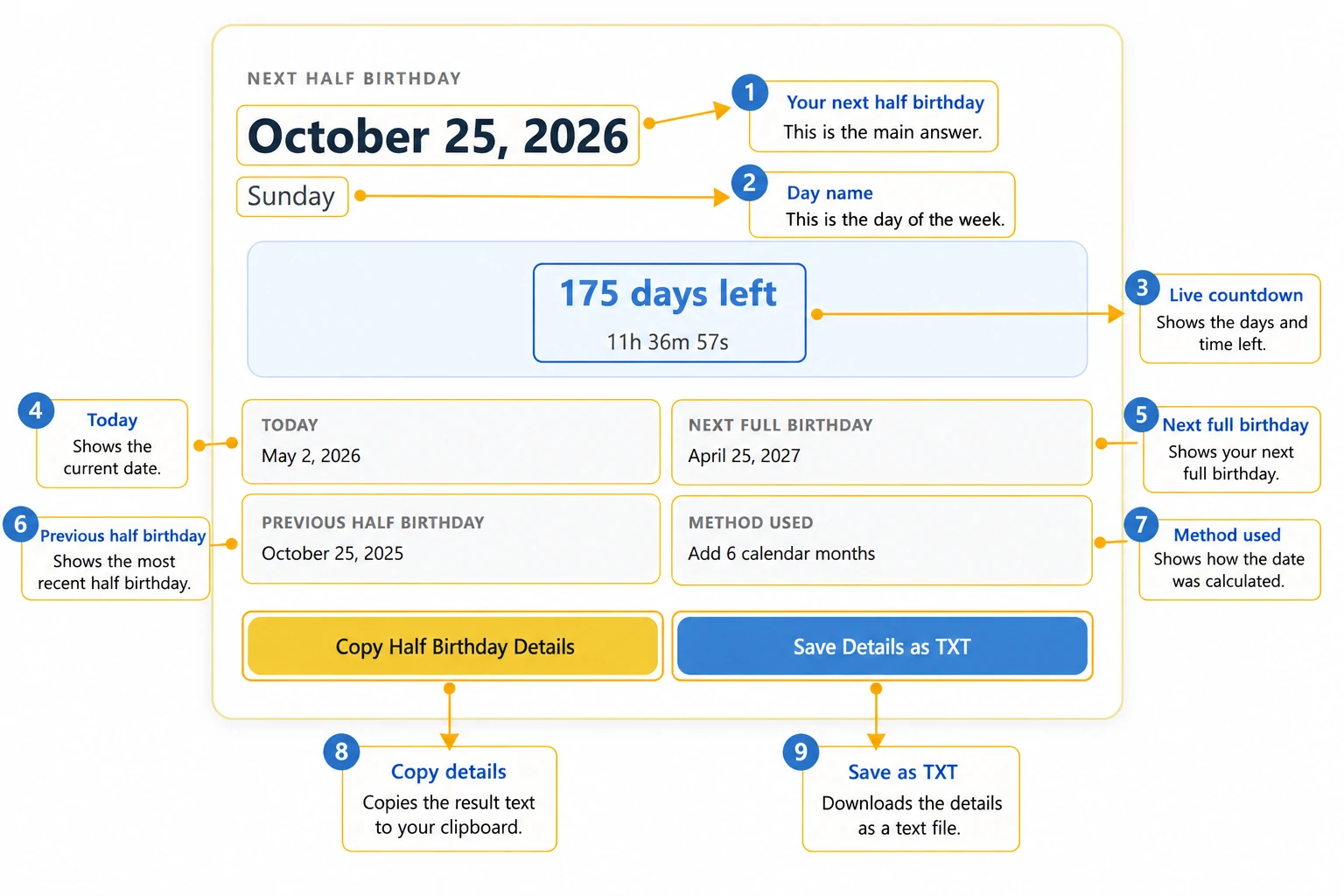
Then the calendar shows its teeth. One month has 31 days. Another has 30. February stays short almost every year and grows a single day only in leap years. If your birthday sits near the end of a month, the halfway date can slide to the last valid day in the target month. That is why people double-check. It is not overthinking. The calendar follows its own rules. A proper calculator cuts through that mess. It gives the exact half birthday date, the day name, and a countdown from today.
People use it in different ways. Some want a fun excuse to celebrate. Parents like six-month baby milestones. Couples use it as a light reminder. Others treat it as a mid-year reset. No matter the reason, you should not have to wrestle with month lengths just to get one date right.
How this calculator gets the right date
This tool finds the next half birthday from today. It does not start from your next full birthday. This step prevents the one-year mistake.
Most people expect the calendar method. This method adds six calendar months and keeps the day number when possible. Some dates need an adjustment if the target month has fewer days. The tool also shows the day name and a countdown. These details help users plan a reminder or a small celebration without confusion.
Why people even bother with this date
People use a half birthday for simple reasons. The date sits in the middle of the year, so it feels like a natural pause. It also gives people a small moment to celebrate without the big build up of a full birthday.
Parents often care the most. Six months is a major baby milestone. Many families take new photos around that time. Some plan a small “half birthday” treat. Others use the date as a reminder to check routines, sleep patterns, or new habits at home.
Couples also like the idea. A half birthday feels casual. It can be a sweet message, a short dinner, or a tiny gift. The day gives them a reason to show care on an ordinary week.
Some people use the date as a personal reset. Six months can show what worked and what did not. It can also help with goals that feel too big in January. A half birthday can push you to adjust your plan, set new targets, or stop wasting time on things that do not matter.
The rule most people follow first
Most people use the same quick rule. They take their birthday and move it ahead by six months. They keep the same day number. That simple shift gives the right answer in many cases. A birthday on April 10 lands on October 10. A birthday on January 5 lands on July 5. These examples feel clean and easy. That is why people trust the rule.
Problems start when the months do not match up. Some months end sooner. Some dates do not exist in the month that comes six months later. That is when the “same day” idea can fail and the result needs an adjustment.
Where the calendar stops playing nice
Some birthdays do not keep the same day after six months. The calendar blocks it. The target month may not have that day number. A person born on August 31 runs into this fast. Six months later lands in February. February has no 31st. The half birthday must move to the last valid day in that month. Most years it becomes February 28. Leap years can make it February 29.
The same issue shows up with October 31. Six months later lands in April. April has 30 days. The date has to shift. February birthdays can also change the result. A February 29 birthday exists only in leap years. The half birthday date can differ if the year has 28 days in February. These are the cases where guesses fail. Many simple calculators fail too. They treat all months as equal, so they return a date that cannot exist.
Dates that need an adjustment
| Birthday date | What happens | Example result |
|---|---|---|
| Aug 31 | February has no 31st | Feb 28 or Feb 29 |
| Oct 31 | April has 30 days | Apr 30 |
| Feb 29 | Exists only in leap years | Adjusts to nearest valid date |
Two different ways tools handle the math
Half birthday tools do not always agree. Two calculators can show two different dates from the same birthday. This happens because they use different rules. Some tools treat a half year as a calendar move. Other tools treat it as a set number of days. Both methods can be correct. The best choice depends on what you want from the result.
| Option | What it does | Best use | Example |
|---|---|---|---|
| Add 6 calendar months | Shifts the month ahead by 6 | Normal calendar planning | Apr 10 → Oct 10 |
| Add 182 days | Uses a fixed day gap | Strict spacing | Jun 1 → Nov 30 or Dec 1 |
Calendar shift method
This method adds six calendar months to your birthday date. The tool tries to keep the same day number. March 15 becomes September 15. May 20 becomes November 20. Most people like this approach because it feels normal. People plan on calendars. They think in months, not in day totals. The date also looks clean in most cases.
Month end birthdays can cause a change. A date like August 31 has no match in February. The tool then moves the result to the last valid day of that month. That keeps the result real and usable.
Fixed day count method
This method adds 182 days to your birthday date. The tool treats a half year as a fixed block of days. The spacing stays consistent in pure math terms. The result can look different from the calendar method. June 1 can land on November 30 or December 1, based on the year. Leap years and different month lengths can shift the final date.
Some people prefer this method when they care about exact spacing. Others dislike it because the day number can change. A good calculator lets users choose, so the result fits their goal.
Which one actually feels right
Most people prefer the calendar method. It keeps the same day number in many cases. April 10 turns into October 10. That feels right because it matches how people talk about dates. The day-count method can still make sense. Some tools track time as exact gaps. A fixed day count helps when you want consistent spacing. This approach fits strict trackers and some apps. A strong calculator should not trap the user in one rule. It should offer both options. People can then pick the method that matches their purpose.
The mistake that makes tools look wrong
Many half birthday tools fail in the same way. They start with the next full birthday first. They add six months to that date. This sounds logical, but it breaks the result for many birthdays.
The tool should not ask, “What is six months after my next birthday?”
It should ask, “What is the next half birthday from today?”
Here is a clear example.
Birthday: December 25
Today: May 2, 2026
Correct next half birthday: June 25, 2026
Wrong result some tools show: June 25, 2027
That one-year jump feels like a small mistake, but it ruins the purpose of the tool. People want the nearest upcoming half birthday. A correct system checks more than one year. It looks at last year, this year, and next year. It then picks the closest date that still sits ahead of today.
Certain months pop up more than others
People search half birthdays in patterns. The calendar creates the pattern. Six months splits the year into pairs, so the same month matches show up again and again.
February searches often come from August birthdays. August 12 usually lands on February 12. Late August birthdays cause more checks because February has fewer days.
June searches often come from December birthdays. December 25 lands on June 25. People also plan summer meetups, so they look it up early.
September searches often come from March birthdays. March birthdays land in September. That month feels like a reset season for many families, so it gets attention.
Weather and school dates also affect search habits. Warm months feel easier for small plans. School schedules push many people to choose the closest weekend.
A fast way to guess your half birthday
You can do a quick check without a tool.
- Move your birthday ahead six months
- Keep the same day number
- Make sure the target month has that day
May 7 becomes November 7. February 14 becomes August 14.
This gives a rough answer. The calculator confirms the exact date and day name.
Why a calculator beats a quick guess
A calculator avoids month-end mistakes and leap-year shifts. It shows the day name and days left from today. That saves time and prevents wrong dates.
It has real uses now, not just a fun idea
Half birthdays used to feel like a small joke. People made a cupcake, took a photo, and moved on. Now the date has real use in everyday life. Schools in the United States give one clear example. Many children have summer birthdays. Classmates may not sit together in summer, so families pick a school-year date instead. A half birthday gives a fair option that falls during the term. Teachers can also plan it without waiting for the next class year.
Families also use the six-month mark as a routine check. Babies change fast in the first year. Six months often brings new feeding patterns, new sleep habits, and new schedules at home. Parents like a clear date that tells them, “We reached another stage.” Adults use the same idea in a different way. Many people review goals twice a year. They check money plans, fitness goals, and work progress. A half birthday works as a personal reminder. It can push someone to fix what is not working and keep what is working.
One small detail that makes results clearer
Many half birthday tools give one date and end the result there. That feels incomplete. People often want to know what comes next, not just one midpoint. A better tool shows two dates side by side. It shows your next half birthday and your next full birthday. This small change makes the result easier to understand at a glance.
This also prevents a common mix-up. Some people think the half birthday must come after the next birthday. That is not always true. A December birthday can have a half birthday in June of the same year, which comes before the December birthday. Showing both dates removes that confusion and makes planning easier.
The idea stays simple, but the calendar adds friction
The core idea stays simple. You take a birthday and move it ahead by half a year. That gives you a half birthday.
The calendar makes it harder than it sounds. Months do not match each other. Some have 31 days. Some have 30. February stays shorter in most years. Leap years add one more twist. A date that looks fine in one month may not exist in the month you land on.
These small details change the final answer. End-of-month birthdays cause the most confusion. Leap day birthdays also need a clear rule. A reliable calculator handles all of this without drama. It shows the correct date, the correct day name, and a clear countdown from today. Most people do not want to do the math. They want the right result fast.
Before you ask, here are the answers
What is a half birthday?
A half birthday falls about six months after your birthday. Many people use it as a mid-year moment to celebrate or reset. Month-end birthdays can shift the result if the target month has fewer days.
How does this calculator decide the result?
The tool finds the next half birthday from today. It does not begin with your next full birthday. It then shows the date, the day name, and a countdown. It also adjusts month-end and leap-year cases.
Why can the half birthday date change?
Some dates do not exist six months later. A birthday on the 30th or 31st can land in a month with fewer days. The result moves to the last valid day of that month.
Which method should you use, 6 months or 182 days?
Six calendar months matches normal date planning. The result usually keeps the same day number. The 182-day method uses a fixed gap, so the day number can shift in some years. Choose the option that fits your goal.
Why do some tools show the wrong year?
Some calculators start from the next full birthday and add six months. This can jump the half birthday into the next year even when a closer date exists. A reliable tool picks the nearest upcoming half birthday from today.
What if your birthday is February 29?
February 29 appears only in leap years. The tool adjusts the result in non-leap years to a valid date based on your selected method. This keeps the result usable.
Does this tool help with baby half birthdays?
Parents often mark the six-month milestone for babies. The tool gives the exact date and day name. The countdown helps plan photos or a small family moment.
Can couples or friends use it too?
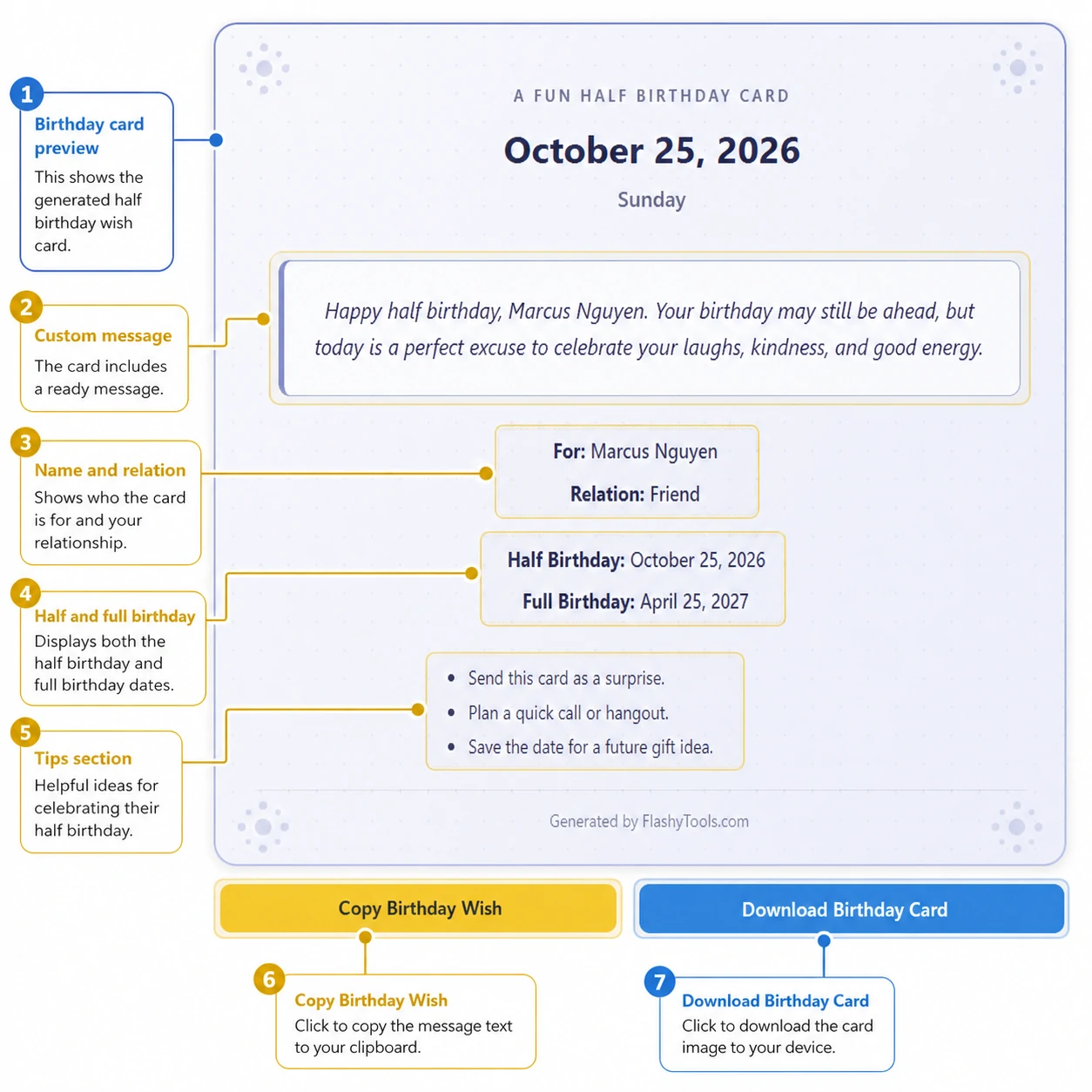
Half birthdays work well as a light reminder. The tool gives a clear date and countdown. The card option helps you copy a ready message fast.
Does the calculator store birthdays or personal data?
The tool runs in your browser. The page does not need an account. Inputs stay on your device during use.
Why can the day name differ across devices?
Time zone settings can change date display. The tool uses your device time zone for the day name and countdown. Check your device time zone if the day looks off.
This calculator runs in your browser. It does not store your inputs. No account required. Your results stay on your device during use.