
Application forms often request percentage marks. Many transcripts show CGPA instead. Both represent academic performance, yet the format does not match.
Students face this issue during job applications, university admissions, and scholarship checks. A form may require percentage even though the record shows CGPA.
Some students attempt a quick calculation. They multiply CGPA with a number they find online. The result may look correct, but the formula may not match their university policy. Each institution can use its own rule.
Modern academic calculators reduce this confusion. Students who follow the CBSE grading system can use a CBSE CGPA to Percentage Calculator to apply the ×9.5 conversion rule automatically and generate the correct percentage.
Knowledge of these formulas helps students confirm results and avoid mistakes when they submit transcripts.
How to Use the CGPA to Percentage Calculator
Follow these steps:
- Enter your CGPA value.
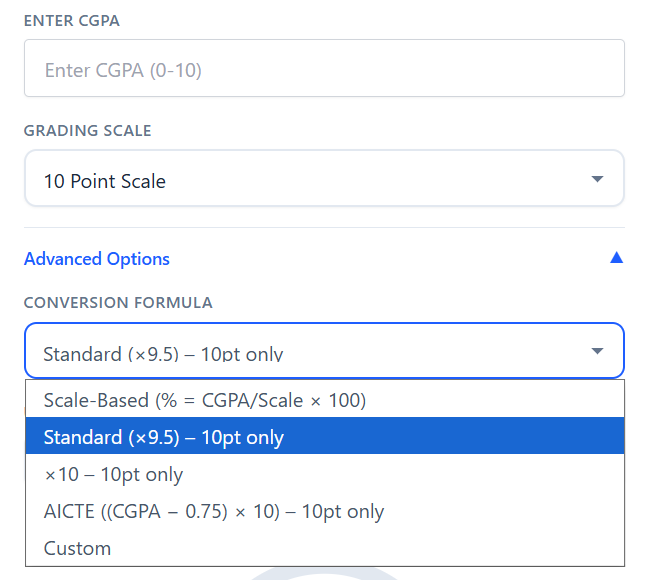
- Select the grading scale used by your university.
- Choose the correct conversion formula.
- View the percentage result instantly.
The calculator automatically applies the selected formula and generates an accurate result without manual calculation.
CGPA to Percentage Calculator Interface
Below is an example of the calculator interface used to convert CGPA into percentage. The tool allows students to select the grading scale and choose the correct formula used by their university.
Why Universities Use Different Conversion Rules
Universities build grading systems based on their own academic structure. Some systems keep CGPA scores within a tight range. Other systems spread grades across a wider scale.
A single conversion rule cannot represent every grading model. Education boards therefore publish formulas that reflect their own grading structure.
Common examples include:
- CBSE uses a multiplier rule
- AICTE recommends an adjusted formula
- Some universities convert CGPA directly to percentage
- International institutions apply scale-based conversion
These rules explain why identical CGPA values may convert into different percentage results.
Different CGPA Grading Scales Used by Universities
Universities do not always use the same grading scale. Many institutions follow a 10-point system, but other academic systems use different scales.
Common grading scales include:
- 4-point scale
- 5-point scale
- 7-point scale
- 8-point scale
- 10-point scale
The conversion formula must match the scale used by the university. A wrong scale produces an incorrect percentage.
Academic calculators solve this issue. Students can select the grading scale first. The tool then applies the correct formula automatically and shows the accurate percentage.
Common Formulas Used to Convert CGPA into Percentage
Academic institutions and calculators often rely on a few widely accepted formulas. Each method works best under a specific grading policy.
The most common methods include:
- Scale-based conversion
- CBSE multiplier rule (×9.5)
- Direct conversion (×10)
- AICTE engineering formula
Each formula produces a different result because the grading structure behind it differs.
Which CGPA Formula Should You Select?
Students often ask which formula they should choose in a CGPA calculator. The correct option depends entirely on the grading rule used by the university.

Use this quick guide:
- CBSE students: choose the ×9.5 multiplier rule
- Many engineering colleges: use the AICTE formula
- Some universities: use the ×10 direct conversion
- International grading systems: use scale-based conversion
If your university publishes a different rule, select the custom formula option and apply the exact method mentioned in your academic policy.
Choosing the correct formula ensures that your converted percentage matches official records.
Scale-Based Conversion Method
Some universities use scale comparison rather than a multiplier. This approach compares CGPA with the maximum grading scale.
The formula is:
Percentage = (CGPA ÷ Scale) × 100
This rule works across different grading systems because it adjusts according to the maximum scale.
Example
Divide CGPA by the scale:
Assume the grading scale equals 10 and a student has 8 CGPA.
8 ÷ 10 = 0.8
Convert the result into percentage:
0.8 × 100 = 80%
This method provides a flexible conversion that adapts to different grading systems.
CBSE Multiplier Method (CGPA × 9.5)
The Central Board of Secondary Education introduced CGPA grading in school education. The board also provided a formula to convert CGPA into percentage.
The rule is simple:
Percentage = CGPA × 9.5
The value 9.5 represents the average relation between CGPA and percentage marks in the board’s grading system.
The CBSE board explains this grading rule in its official academic guidelines. Students can review the grading structure on the official CBSE website.
Example
A student receives 8 CGPA.
8 × 9.5 = 76%
Under the CBSE rule, 8 CGPA equals about 76 percent.
Many entrance forms and academic institutions accept this multiplier when reviewing CBSE transcripts.
Direct Conversion Method (CGPA × 10)
Certain universities prefer a direct conversion. This method treats CGPA as a proportional value of the grading scale.
The formula is:
Percentage = CGPA × 10
Example
If the CGPA equals 8.7:
8.7 × 10 = 87%
Several technical institutes and private universities use this rule. Institutional policy always determines which formula applies.
AICTE Formula Used in Engineering Institutions
Engineering colleges often follow guidelines issued by the All India Council for Technical Education.
This formula adjusts CGPA slightly before conversion.
The rule is:
Percentage = (CGPA − 0.75) × 10
The adjustment corrects grading differences that may appear in engineering evaluation systems.
Engineering students from Savitribai Phule Pune University often follow a different rule under the CBCS system. The detailed SPPU CGPA to Percentage Conversion Engineering & CBCS Pattern guide explains how that university calculates percentage from CGPA.
Example
Suppose a student has 7.6 CGPA.
First subtract the adjustment value:
7.6 − 0.75 = 6.85
Then convert to percentage:
6.85 × 10 = 68.5%
Under this rule, 7.6 CGPA becomes about 68.5 percent.
Engineering universities that follow AICTE guidance often apply this formula.
When Universities Use a Custom CGPA Conversion Formula
Some universities do not follow the common formulas used by CBSE or AICTE. They publish their own conversion rule in academic guidelines.
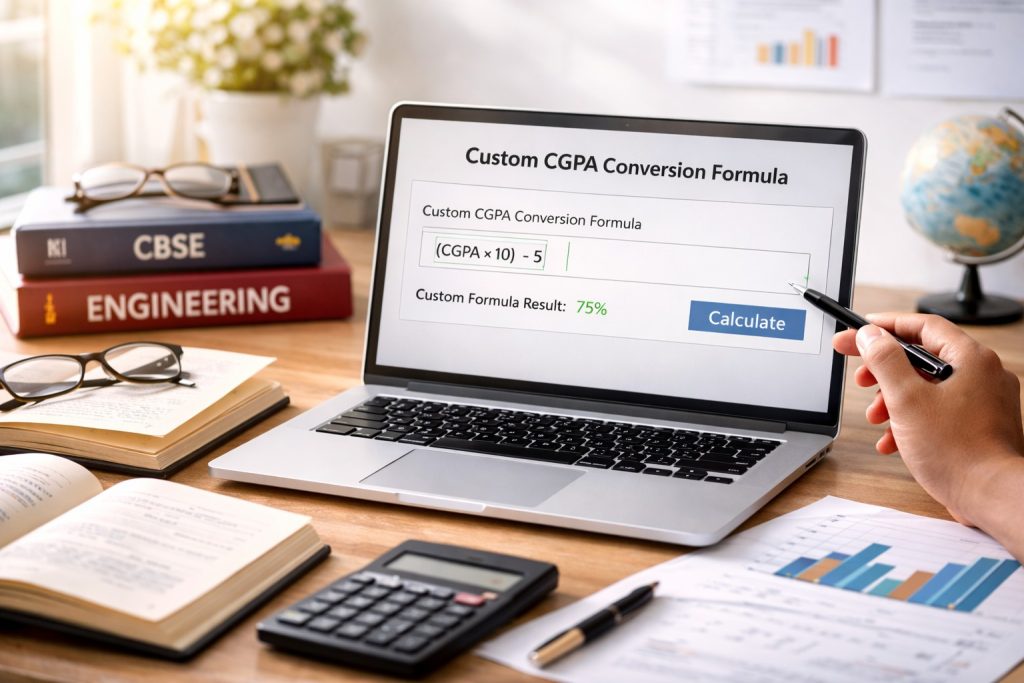
In such cases, the student must apply the exact formula defined by the institution.
Example rules may look like this:
Percentage = (CGPA × 9.3)
Percentage = (CGPA × 10) − 5
These formulas vary across universities. A standard multiplier may not produce the correct value.
Many CGPA conversion tools include a custom formula option. This allows students to apply the exact rule provided by their university and generate the correct percentage instantly.
Converting CGPA from a 4-Point Grading Scale
Many universities outside India use a 4-point GPA scale instead of a 10-point CGPA system.
Percentage conversion requires proportional scaling.
The formula becomes:
Percentage = (CGPA ÷ 4) × 100
Example
Assume the CGPA equals 3.2.
3.2 ÷ 4 = 0.8
0.8 × 100 = 80%
A 3.2 GPA roughly equals 80 percent under this scale.
Universities often perform their own transcript evaluation when reviewing international grades.
Examples Students Often Search
Students frequently look for quick values rather than formulas.
10 CGPA in Percentage
CBSE method:
10 × 9.5 = 95%
Direct conversion method:
10 × 10 = 100%
8 CGPA in Percentage
CBSE method:
8 × 9.5 = 76%
Direct conversion method:
8 × 10 = 80%
AICTE method:
(8 − 0.75) × 10 = 72.5%
Different formulas produce different results. The correct rule depends on the institution.
Students who want a quick estimate without doing manual calculations can check the CGPA to Percentage Conversion Chart with Reference Table, that lists common CGPA values and their approximate percentage equivalents.
Quick CGPA to Percentage Reference
| CGPA | ×9.5 Method | ×10 Method |
|---|---|---|
| 6.0 | 57% | 60% |
| 7.0 | 66.5% | 70% |
| 8.0 | 76% | 80% |
| 9.0 | 85.5% | 90% |
| 10.0 | 95% | 100% |
These values provide a quick estimate. Official conversion still depends on the formula used by the institution.
Common CGPA to Percentage Conversion Mistakes
Students sometimes convert CGPA incorrectly because they assume all universities follow the same rule.
The most common mistakes include:
- Using the ×9.5 formula for universities that require AICTE conversion
- Ignoring the grading scale before calculating percentage
- Using a 10-point conversion for a 4-point grading system
- Applying a random multiplier found online
These mistakes can produce incorrect academic results. A small difference in percentage may affect admission or scholarship eligibility.
Always check the official conversion rule of your institution before calculating the result.
Manual Steps to Convert CGPA into Percentage
Students can calculate the result manually if they know the correct formula.
Follow these steps:
- Identify the formula used by the university
- Apply the multiplier or adjustment value
- Verify the result with official academic guidelines
Manual calculation works well when the formula is known. Many students still prefer automated tools because calculators reduce arithmetic mistakes.
Reverse Conversion: Percentage to CGPA
Some applications request CGPA instead of percentage. Reverse conversion requires the grading scale.
Students who want to convert marks in the opposite direction can review a detailed Percentage to CGPA Conversion Chart with All Scales Explained to understand how percentage values map back to CGPA across different grading scales.
The formula is:
CGPA = (Percentage ÷ 100) × Scale
Example
Assume the percentage equals 87 percent and the grading scale equals 10.
87 ÷ 100 × 10 = 8.7 CGPA
A different grading scale produces a different CGPA value.
Students should always confirm the grading scale used by their university before applying reverse conversion formulas.