
Medication timing looks simple on paper. Real life makes it tricky. A dose time can clash with work, school, meals, sleep, or travel. That is when a short label starts to feel confusing.
Two labels often confuse people. One says “every 8 hours.” The other says “3 times a day.” Both give three doses in one day. That is where the similarity ends. The timing logic is different, and that difference can affect how steady the medicine stays in your body.
This matters most with antibiotics, pain medicine, and any drug that depends on regular gaps. A loose schedule may work for one medicine. Another medicine may need exact spacing.
The real difference in one view
Both labels can mean three doses in one day. That is why people mix them up. The real difference is not the dose count. It is the gap between each dose. Every 8 hours” follows a strict clock. Each dose must stay 8 hours apart. “3 times a day” follows your daily routine. The gaps can change based on meals, wake time, and sleep time.
This is where timing changes everything. One method keeps equal spacing across the full day. The other method fits your lifestyle and allows uneven gaps.
| Instruction | Total Doses | Gap Style | Night Dose | Flexibility |
|---|---|---|---|---|
| Every 8 hours | 3 doses | Equal gaps of 8 hours | Often yes | Low |
| 3 times a day | 3 doses | Uneven daily gaps | Rare | High |
This table shows the main point. Same dose count. Different timing rule.
Fixed 8-Hour Dose Pattern
This schedule follows a strict clock. Your first dose controls the full day. If you begin at 6:00 AM, the next doses fall at 2:00 PM and 10:00 PM. If you start at 7:00 AM, the next doses move to 3:00 PM and 11:00 PM. A start at 8:00 AM shifts them to 4:00 PM and 12:00 AM.
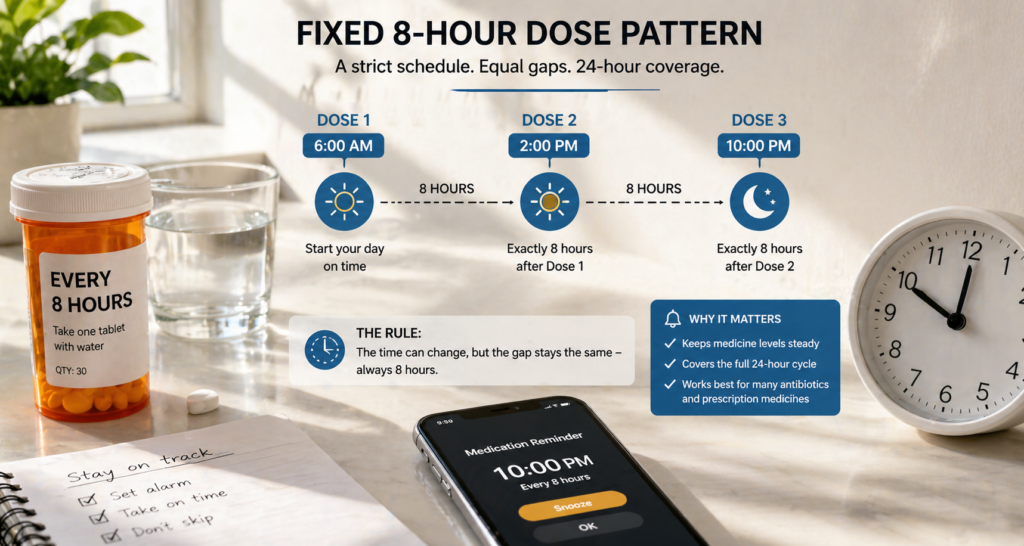
The gap stays exactly 8 hours each time. The dose times can change, but the spacing never changes. That is the main rule. Even a small delay can shift the full schedule. If you take one dose late, the next one also moves forward. This method can feel hard in real life. A late-night dose may fall close to sleep. Some people forget it.
Others delay it and try to fix the schedule the next day. That creates uneven gaps and breaks the timing. This pattern works best when the medicine needs steady levels in your body. It covers the full 24-hour cycle. If the label says every 8 hours, follow the clock and use reminders to stay on track.or change. It works best when the medicine needs steady levels through the full day and night.
Flexible Daily Dose Pattern
A flexible daily dose pattern works around your normal day. It does not force each dose into an exact 8-hour gap. Most people place the medicine in three easy parts of the day: morning, afternoon, and evening. A common plan may look like 7:30 AM, 1:30 PM, and 9:00 PM. If you wake later, the plan can shift to 9:00 AM, 3:00 PM, and 10:00 PM.
The dose times move with your routine. The gaps do not stay equal here. The morning-to-afternoon gap may feel shorter. The evening-to-next-morning gap may feel longer because of sleep. That is normal when the medicine allows flexible timing. This method feels easier for daily life.
You can connect doses with breakfast, lunch, dinner, or bedtime. It helps users remember medicine without night alarms. This pattern works best when the label says 3 times a day and does not require strict spacing. It gives some freedom, but you still need a steady routine. Try to keep dose times close each day so the plan stays clear.
Does 3 Times a Day Mean Every 8 Hours?
Many people think these two instructions mean the same thing. Both give three doses in one day, so the confusion feels natural. The key difference is not the number of doses. The real difference is how those doses are spaced. A strict 8-hour plan follows the clock across the full 24-hour day. A 3 times a day plan usually fits inside your daily routine. One keeps equal gaps. The other allows uneven gaps based on meals and sleep.
| Instruction | Example Times | Gap Type | Night Dose | Flexibility |
|---|---|---|---|---|
| Every 8 hours | 7:00 AM → 3:00 PM → 11:00 PM | Equal (8 hours) | Often yes | Low |
| 3 times a day | 7:30 AM → 1:30 PM → 9:00 PM | Uneven | Rare | High |
It does not always mean every 8 hours. This is the main point users need to understand. 3 times a day tells you how many doses to take in one day. It does not always tell you the exact gap between each dose. A strict 8-hour plan is different. It follows the clock. If your first dose is at 7:00 AM, the next dose comes at 3:00 PM, and the third dose comes at 11:00 PM.
That schedule keeps the same gap all day. A normal 3 times a day plan can fit your daily routine. It may follow breakfast, lunch, and evening time. The gaps may look uneven, but that can be fine when the medicine allows flexible timing.
Does 3 Times a Day Mean Every 4 Hours?
No. 3 times a day does not mean every 4 hours. It means three total doses in one full day. The confusion starts when people count only the hours they stay awake. They try to fit all three doses into a short daytime window. That can place doses too close together and change the safe timing plan.
Common mistake
- Many people count only daytime hours and ignore the full 24-hour day.
- They try to fit all three doses into a short window.
- This can place doses too close together and make the schedule unsafe.
Why every 4 hours is different
- Every 4 hours means the dose repeats six times in 24 hours.
- Example: 6 AM, 10 AM, 2 PM, 6 PM, 10 PM, 2 AM
- That is a completely different plan from 3 times a day.
Why this can be risky
- It can double the amount of medicine in one day.
- It may raise the chance of side effects.
- It can cause stomach upset, sleep issues, or unsafe drug levels.
Every 8 Hours Is How Many Times a Day?
Every 8 hours equals three times a day. A full day has 24 hours, and 24 divided by 8 gives 3. That means the medicine repeats three times in one full day, with equal spacing between each dose. The count sounds easy, but the schedule can feel strict. If your first dose is at 7:00 AM, the next dose comes at 3:00 PM, and the third dose comes at 11:00 PM. If your first dose starts at 9:00 AM, the next doses move to 5:00 PM and 1:00 AM.
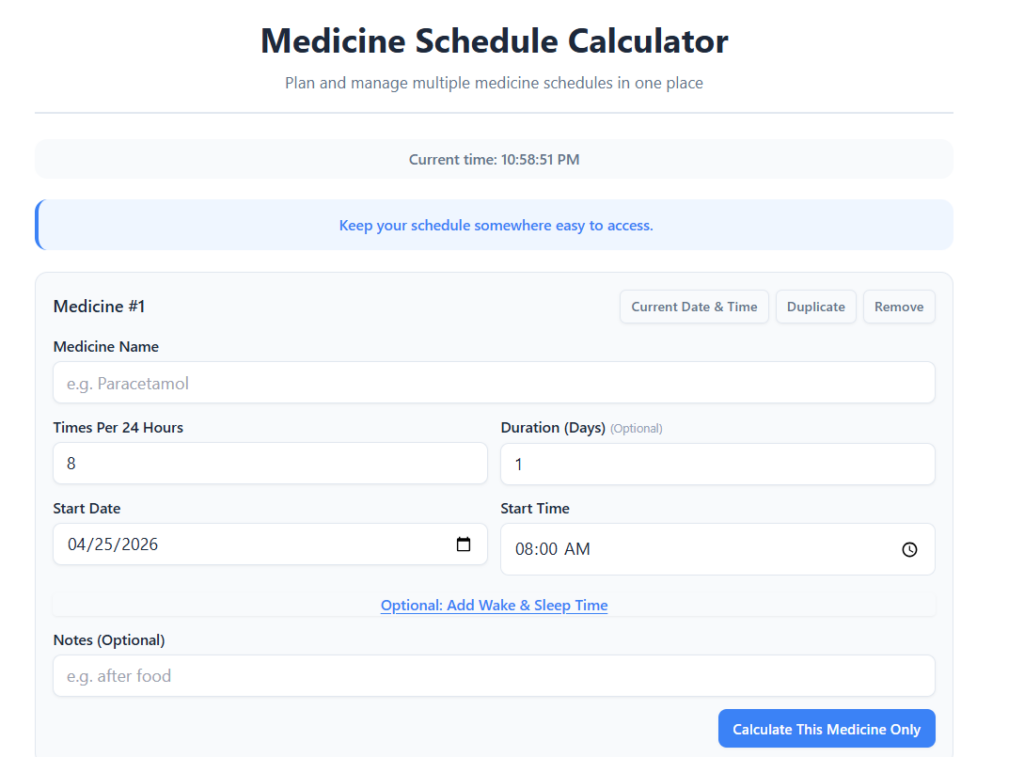
This is where many people get confused. The dose count stays the same, but the time can move into sleep hours. A late start can push the last dose past midnight.
That is why an every 8 hours plan can feel harder than a normal 3 times a day plan. Some people forget the night dose. Others delay it until morning. Both choices can break the equal 8-hour gap.
A better approach is to choose a start time you can follow each day. Keep the same gap between doses. You can also use a simple calculator to map exact dose times, so you do not guess or place doses too close together.
If you feel unsure about exact timing, you can use an every 8 hours medication times calculator to generate a full schedule based on your start time.
How 4 Daily Doses Change the Timing
A 4 times a day medication schedule works very differently from a 3-dose plan. It adds one extra dose, so the gaps become shorter. Instead of wide spacing, the doses come closer together across the full day. Most strict 4-dose plans follow a 6-hour gap. If you start at 6:00 AM, the next doses fall at 12:00 PM, 6:00 PM, and 12:00 AM. If you start later at 8:00 AM, the pattern shifts to 2:00 PM, 8:00 PM, and 2:00 AM.
| Dose Number | Example Time |
|---|---|
| Dose 1 | 6:00 AM |
| Dose 2 | 12:00 PM |
| Dose 3 | 6:00 PM |
| Dose 4 | 12:00 AM |
This schedule often includes a late-night or early-morning dose. That is why many people find it harder to follow than a 3 times a day plan. A missed or delayed dose can quickly break the timing pattern. This type of schedule should not be guessed. If your label says 4 times a day, follow the exact timing or ask a pharmacist for a clear plan. In some cases, doctors may adjust the times to fit your routine, but the goal is still to keep the gaps as steady as possible.
Same Day, Two Different Schedules
This example shows how the same day can feel very different depending on the schedule. Let’s say you wake at 7:00 AM and sleep at 11:00 PM. Both plans give three doses, but the timing pattern changes how easy they are to follow.
3 Times a Day Plan
This plan fits your routine. It usually follows meals or daily habits, so it feels natural to remember.
| Dose | Time |
|---|---|
| Morning dose | 7:30 AM |
| Afternoon dose | 1:30 PM |
| Evening dose | 9:00 PM |
The gaps are not equal, but that is acceptable when the medicine allows flexible timing. This plan avoids night doses, so you do not need alarms during sleep. It works well for people who prefer a simple daily routine.
Every 8 Hours Plan
This plan follows a strict clock. Each dose must stay exactly 8 hours apart, no matter your routine.
| Dose | Time |
|---|---|
| Dose 1 | 7:00 AM |
| Dose 2 | 3:00 PM |
| Dose 3 | 11:00 PM |
The spacing stays exact, but the schedule can feel harder. The last dose often comes close to bedtime. If you start later in the day, the final dose may move past midnight, which can disturb sleep. This comparison shows the key difference. One plan fits your lifestyle. The other follows strict timing rules.
Why Antibiotic Schedules Cause Confusion
Other antibiotics allow more flexible timing. Your doctor may write “3 times a day” because exact 8-hour gaps are not required for that medicine. The main goal is to spread three doses across the day without strict clock pressure.

This gives you room to fit doses into your routine. Many people take them with breakfast, lunch, and dinner. A simple plan may look like 8:00 AM, 2:00 PM, and 9:00 PM. The gaps are not equal, but they stay steady each day.
This approach can feel easier to follow. It works well for people with busy schedules, work shifts, or sleep needs. It also helps when the medicine is easier to take with food. Even with flexibility, you still need balance. Do not take doses too close together or leave very long gaps.
Keep the timing close each day so the medicine works as expected. If you feel unsure, ask your doctor or pharmacist about the best spacing for your case. A simple daily routine is fine, but it should still follow clear timing.
Common Prescription Short Forms
Many prescriptions use short codes instead of full words. These codes can change the whole schedule, so they matter. A small difference between TID and Q8H can mean flexible timing or strict spacing.
| Abbreviation | Meaning | Timing Style |
|---|---|---|
| TID | 3 times a day | Usually flexible |
| Q8H | Every 8 hours | Strict 8-hour gaps |
| QID | 4 times a day | Often every 6 hours |
These short forms help explain how strict the schedule should be. If the label uses a code and you feel unsure, ask the pharmacist before you set dose times..
How to avoid timing mistakes
Small errors can change results. These simple checks help:
- Pick a clear start time and stay consistent
- Do not double doses after a missed one
- Avoid random shifts in an 8-hour plan
- Use daily habits for flexible schedules
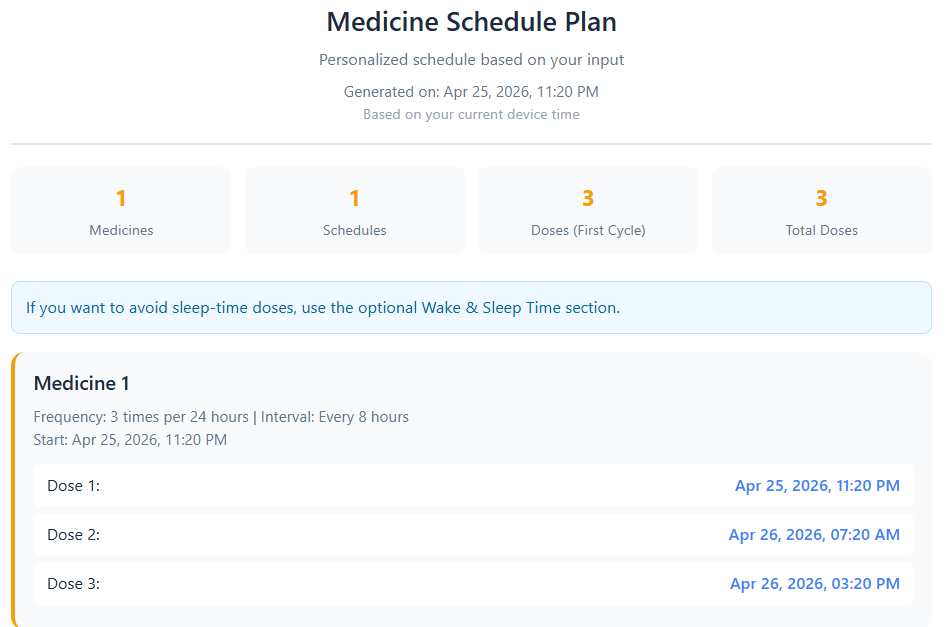
If timing feels confusing, use a simple planner. This medicine schedule calculator helps you set exact dose times based on your start time and daily routine.
When Strict or Flexible Timing Fits Better
The label should guide the schedule. Do not choose the timing style based only on comfort. Some medicines need exact gaps. Others can fit your normal day.
| Situation | Better Choice | Reason |
|---|---|---|
| Drug needs steady levels | Every 8 hours | Keeps equal gaps |
| Drug allows flexible timing | 3 times a day | Fits daily routine |
| Night doses are required | Every 8 hours | Covers full 24 hours |
| Doses can follow meals | 3 times a day | Easier to remember |
This table gives a quick way to understand the difference. The safest choice is always the one written on your label or explained by your doctor.
One Last Practical Note
Timing is not only about how many doses you take. It also depends on the gap between each dose. Three doses can follow strict hours or a simple daily routine.
Many people only see “three doses” and ignore the spacing. That is where mistakes happen. A dose taken too soon can be unsafe. A dose taken too late can weaken the plan.
Read the label as a timing rule, not just a dose count. Once you understand the gap, “every 8 hours” and “3 times a day” become much easier to follow.