
A university form asks for CGPA. Your marks sheet shows percentage. That gap creates doubt. Many students divide marks by 10 and enter the result. That method works in some universities. It fails in others.
Each institution follows its own grading structure. The maximum scale, any adjustment rule, and the rounding policy decide the final CGPA. A small shift in number can affect admission, scholarship approval, or job shortlisting.
This guide explains percentage to CGPA conversion across 10-point, 8-point, 7-point, 5-point, and 4-point systems. Clear formulas and tables appear below for each scale.
Confirm the Scale Before Any Formula
Do not begin with calculation. Confirm the grading system first. Universities use different maximum values.
| Scale | Maximum CGPA | Common Use |
|---|---|---|
| 10-point | 10 | India, Pakistan |
| 8-point | 8 | Autonomous colleges |
| 7-point | 7 | Select institutions |
| 5-point | 5 | Some Asian systems |
| 4-point | 4 | USA, Canada |
The maximum scale decides the formula. A correct formula with the wrong scale still gives a wrong result.
Percentage to CGPA Out of 10 (Direct Method)
Many universities in India and Pakistan use a 10-point CGPA system. The highest value on this scale is 10. Your final CGPA must stay within that limit.
In institutions that follow direct conversion, the rule stays simple:
CGPA = Percentage ÷ 10
If your score is 70%, divide it by 10.
70 ÷ 10 = 7.0 CGPA
If your score is 82%, the result becomes:
82 ÷ 10 = 8.2 CGPA
This approach applies only when the university does not use any multiplier or deduction rule. Some institutions clearly state in their academic handbook that percentage divided by 10 equals CGPA. Others apply different formulas.
Always read your university’s grading policy before you enter any value in an admission or job form. A small formula change can shift your CGPA and affect eligibility where cut-off scores matter.
10-Point Conversion Table
| Percentage | CGPA |
|---|---|
| 60% | 6.0 |
| 65% | 6.5 |
| 70% | 7.0 |
| 75% | 7.5 |
| 80% | 8.0 |
| 85% | 8.5 |
| 90% | 9.0 |
This table provides a quick reference for common scores.
When the 9.5 Rule Applies
Certain boards and universities use the 9.5 rule in their grading system. They calculate percentage from CGPA through multiplication by 9.5. If you convert percentage back into CGPA under this system, you must divide by 9.5.
Use this formula:
CGPA = Percentage ÷ 9.5
Suppose your marks show 70%.
70 ÷ 9.5 = 7.36 CGPA
Now compare this result with the direct 10-point method. Under simple division by 10, the same 70% equals 7.0 CGPA. Under the 9.5 rule, the value rises to 7.36.
That gap can influence eligibility in courses where minimum CGPA matters. Always confirm your university rule before you enter any number in an application form.
9.5 Rule Conversion Table
| Percentage | CGPA |
|---|---|
| 60% | 6.32 |
| 70% | 7.36 |
| 80% | 8.42 |
| 90% | 9.47 |
Always check whether your institution follows this rule before entry.
Percentage to CGPA Out of 8
Some autonomous colleges use an 8-point grading scale. In this system, the highest CGPA is 8. The conversion adjusts your percentage to that limit.
Use this formula:
CGPA = (Percentage ÷ 100) × 8
Example:
75%
75 ÷ 100 = 0.75
0.75 × 8 = 6.0 CGPA
8-Point Conversion Table
| Percentage | CGPA (Out of 8) |
|---|---|
| 60% | 4.8 |
| 70% | 5.6 |
| 80% | 6.4 |
| 90% | 7.2 |
This system scales marks directly to 8.
Percentage to CGPA Out of 7
A few institutions follow a 7-point grading structure. The method remains proportional.
Formula:
CGPA = (Percentage ÷ 100) × 7
Example:
70%
70 ÷ 100 = 0.70
0.70 × 7 = 4.9 CGPA
7-Point Conversion Table
| Percentage | CGPA (Out of 7) |
|---|---|
| 60% | 4.2 |
| 70% | 4.9 |
| 80% | 5.6 |
| 90% | 6.3 |
This format is less common but still used in selected programs.
Percentage to CGPA Out of 5
Some universities adopt a 5-point scale. The conversion follows the same pattern.
Formula:
CGPA = (Percentage ÷ 100) × 5
Example:
80%
80 ÷ 100 = 0.80
0.80 × 5 = 4.0 CGPA
5-Point Conversion Table
| Percentage | CGPA (Out of 5) |
|---|---|
| 60% | 3.0 |
| 70% | 3.5 |
| 80% | 4.0 |
| 90% | 4.5 |
This scale appears in certain Asian institutions.
Percentage to CGPA Out of 4
Many international universities use a 4-point scale. This method supports global comparison.
Formula:
CGPA = (Percentage ÷ 100) × 4
Example:
75% → 3.0 CGPA
85% → 3.4 CGPA
4-Point Conversion Table
| Percentage | CGPA (Out of 4) |
|---|---|
| 60% | 2.4 |
| 70% | 2.8 |
| 80% | 3.2 |
| 90% | 3.6 |
This approach converts marks directly to the 4-point system.
Same Percentage Across Different Scales
Take 70% as an example.
| Scale | CGPA Result |
|---|---|
| 10-point (÷10) | 7.0 |
| 10-point (÷9.5) | 7.36 |
| 8-point | 5.6 |
| 7-point | 4.9 |
| 5-point | 3.5 |
| 4-point | 2.8 |
The grading scale alone changes the final value.
If you are unsure which formula your university follows, you can use a multi-scale Percentage to CGPA Calculator that supports 10, 8, 7, 5, and 4-point systems. Select your scale and apply the correct formula instantly.
Reverse Conversion Examples
Students often convert CGPA back into percentage.
If you need the reverse method, see the complete CGPA to Percentage Conversion Chart (0-10 Quick Reference Table) for detailed examples and formula breakdown.
7.6 CGPA in Percentage
| Method | Result |
|---|---|
| ×9.5 | 72.2% |
| ×10 | 76% |
2.5 CGPA in Percentage
| Scale | Result |
|---|---|
| Out of 4 | 62.5% |
| Out of 10 | 25% |
10 CGPA in Percentage
| Method | Result |
|---|---|
| ×9.5 | 95% |
| ×10 | 100% |
7.5 CGPA in Percentage
| Method | Result |
|---|---|
| ×9.5 | 71.25% |
| ×10 | 75% |
Each formula produces a different outcome. Always match the method to your institution.
Rounding Policy Can Change the Result
Universities apply different rounding rules:
- Two decimal places
- One decimal place
- Nearest 0.5
Rounding affects the final printed CGPA. Follow your official academic regulation.
Common Mistakes to Avoid
Students often assume one formula works everywhere. Some use the wrong scale. Others confuse SGPA with CGPA. Many ignore rounding rules.
Even a small error can create mismatch during document verification.
Printable Conversion Chart PDF
You can download a clean printable version of the full multi-scale conversion chart below. It includes 10-point, 9.5 rule, 8, 7, 5, and 4-point tables with formula reference.
This PDF works as a quick offline reference during admission forms, scholarship applications, or job submissions.
Chart or Calculator?
A chart gives fixed reference values. It assumes one clear formula per table. It works well when the grading rule is already known.
A multi-scale calculator adapts to different systems and it adjusts for 10, 8, 7, 5, and 4-point scales. It applies the correct formula automatically, It supports forward and reverse conversion and it also reduces small manual errors.
Use a chart for quick lookup. Use a calculator when accuracy matters.
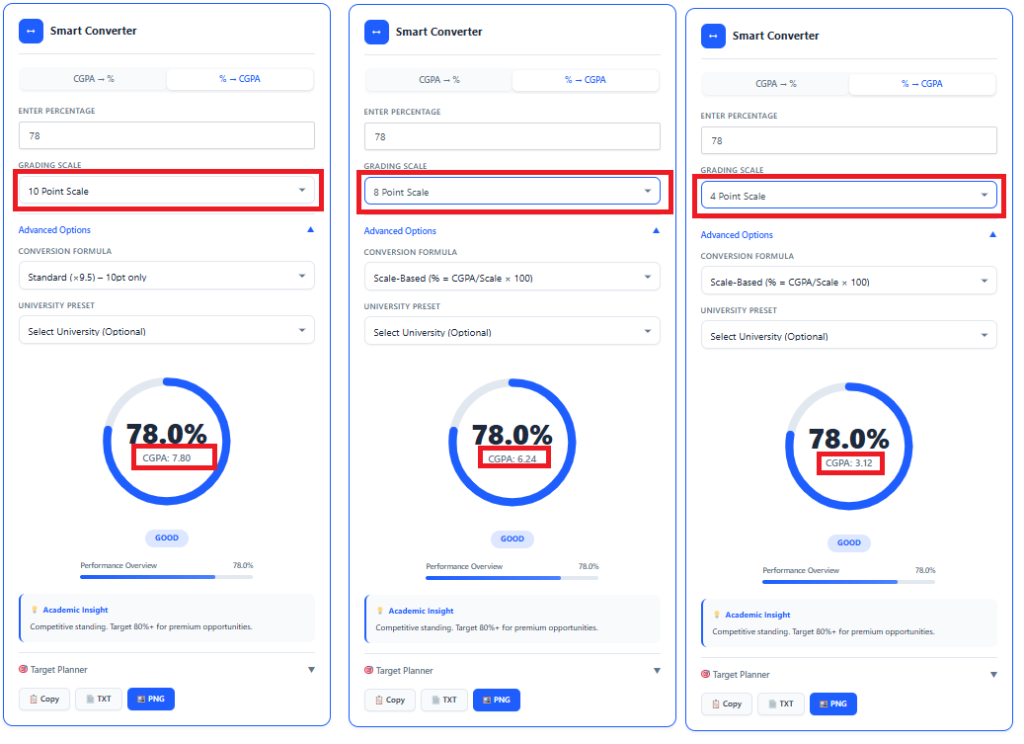
The calculator below demonstrates how the same percentage produces different CGPA values when the grading scale changes.
Final Check Before Submission
Before you enter any CGPA value, confirm these points:
- Official grading scale
- Exact conversion formula
- Any multiplier or adjustment rule
- Rounding policy
Percentage to CGPA conversion depends fully on institutional rules. One formula does not apply to every system. Always rely on official academic guidelines before final submission.
Some universities calculate CGPA based on credit-weighted averages instead of simple scaling. In such cases, percentage conversion may not match direct formulas. Always check academic regulations before final submission.
Students from Savitribai Phule Pune University can refer to the detailed SPPU CGPA to Percentage Conversion (Engineering & CBCS Pattern) guide for university-specific calculation rules.