
Some riders inflate tyres to the maximum number printed on the sidewall. Others copy a friend’s setup. That approach often ignores the one factor that matters most: rider weight. Your body weight changes how much the tyre compresses against the road. That compression controls grip, comfort, and speed. A light rider and a heavy rider cannot use the same PSI and expect the same feel.
This guide focuses only on weight. It does not repeat wider surface or rim discussions. It goes deeper into how weight shifts front and rear pressure in real riding. If you want broader context about road surface, tyre width, and casing design, you can review the full explanation in this detailed road bike tyre pressure guide. Here we stay focused on rider load.
How Rider Weight Changes PSI
A road bike usually carries more weight on the rear wheel than the front. Many setups sit close to a 40/60 split. That means rear pressure must stay slightly higher. Heavier riders compress the tyre more. They need extra PSI to keep the tyre stable. Lighter riders compress it less. They need lower PSI to avoid a harsh ride.
This is why people often search for a road bike tyre pressure by rider weight chart. Charts group riders into weight brackets and give safe ranges. They work well as a starting point.
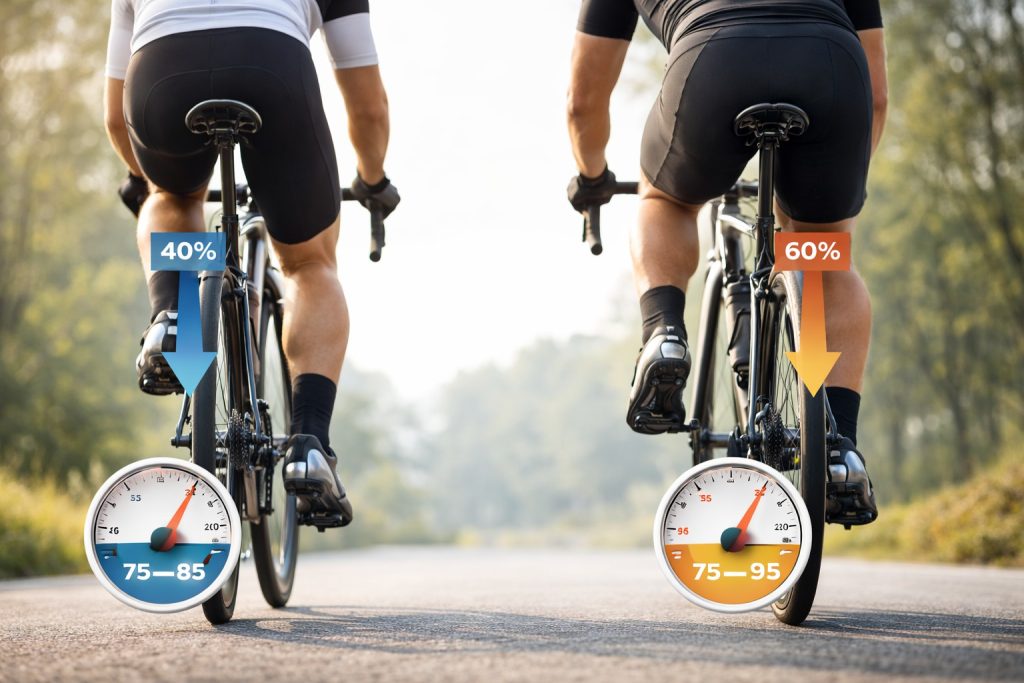
Here is a practical range for 25 mm tyres on smooth asphalt:
- 55-65 kg rider
- Front 70-78 PSI
- Rear 75-85 PSI
- 65-75 kg rider
- Front 75-85 PSI
- Rear 80-92 PSI
- 75-85 kg rider
- Front 82-92 PSI
- Rear 88-100 PSI
- 85-95 kg rider
- Front 90-100 PSI
- Rear 95-110 PSI
These numbers assume modern road tyres and a balanced riding position. Wider tyres such as 28 mm require lower PSI at the same weight.
Many tyre guides publish pressure tables that recommend inflation based on your body weight and tyre width, such as this tire pressure recommendations based on rider weight and tyre width chart.
If you move from 25 mm to 28 mm tyres, you can usually reduce pressure by 5 to 10 PSI at the same rider weight.
Always stay below the maximum pressure printed on your tyre and rim.
Why Front and Rear Should Not Match
Many riders inflate both tyres to equal pressure. That feels simple but rarely performs best. Rear wheel supports more mass. Saddle position and pedal force increase that load. Rear PSI should sit about 5 to 10 percent higher than the front.
Example:
- A 78 kg rider on 25 mm tyres might run
- Front 88 PSI
- Rear 96 PSI
That small difference improves corner stability and reduces rear squirm under power. This also answers a common question about bicycle tyre pressure front and back. They should not be identical unless weight distribution changes in a special case.
Using a Calculator Instead of Guessing
Riders often search online for a tyre pressure calculator road bike. The reason is simple. Manual charts do not account for tyre width, rim size, and setup type at the same time.
System weight means rider weight plus bike weight. Most road bikes add around 8 to 12 kg including bottles and small gear.
A proper calculator uses system weight. That includes rider plus bike. It then adjusts PSI for front and rear separately.
If you want structured output instead of rough ranges, try this practical tyre pressure calculator. It allows you to enter rider weight, tyre width, wheel size, and setup type. It returns front and rear values based on load logic. Some brands also provide their own tools. Some brands provide their own tools. Weight remains the base input in every case. Brand tools adjust numbers based on casing design. Weight still remains the base input in every case.
Tube, Tubeless, and Weight Interaction
Setup type changes how weight translates into PSI. Tubeless systems allow slightly lower pressure. They reduce pinch flat risk and support better grip under load. Tube setups often need a few extra PSI to stay safe under heavier riders.
Take an 80 kg rider on 25 mm tyres:
Tubeless setup
- Front 85 PSI
- Rear 94 PSI
Tube setup
- Front 88 PSI
- Rear 98 PSI
The weight stays the same. The system type changes the safe pressure window.
Read Also: Silca vs SRAM Tire Pressure Calculator: Real-World Accuracy Test
Converting to kg/cm2
Some riders prefer metric units and search for bike tyre pressure in kg/cm2. Conversion is simple.
1 PSI equals about 0.07 kg/cm2.
- If you run 90 PSI, that equals roughly 6.3 kg/cm2.
- If you run 100 PSI, that equals about 7 kg/cm2.
This helps riders who use pumps marked in metric pressure only.
A Short Real Example
A rider weighs 72 kg. He runs 25 mm tyres at 95 PSI front and rear because a shop once recommended that value. Ride feels stiff. Hands feel tired after long sessions. Rear wheel feels firm under sprint.
He adjusts based on weight bracket:
- Front 82 PSI
- Rear 90 PSI
Ride comfort improves. Control feels more stable in turns. Speed does not drop. This small shift shows why a road bike tire pressure chart based on rider weight matters more than copying someone else’s number.
Fine Tuning After First Ride
Start within your weight range. Ride at normal pace for at least 30 km. If front feels harsh over smooth asphalt, reduce 2 PSI. If rear feels soft under hard effort, increase 2 PSI. Change one value at a time. Keep notes. Small adjustments matter more than large swings. Heat also changes pressure. Check PSI before riding, not after.
Once you calculate weight-based PSI, surface type becomes the next adjustment step. See our Tire Pressure Guide for Different Road and Trail Surfaces for terrain-based tuning.
Pingback: Road Bike Tyre Pressure: Weight, Width, Surface Guide
Pingback: Tire Pressure Guide for Different Road and Trail Surfaces